



Cecil County Council Candidate Aaron Wright’s Criminal History Raises Questions Ahead of Election
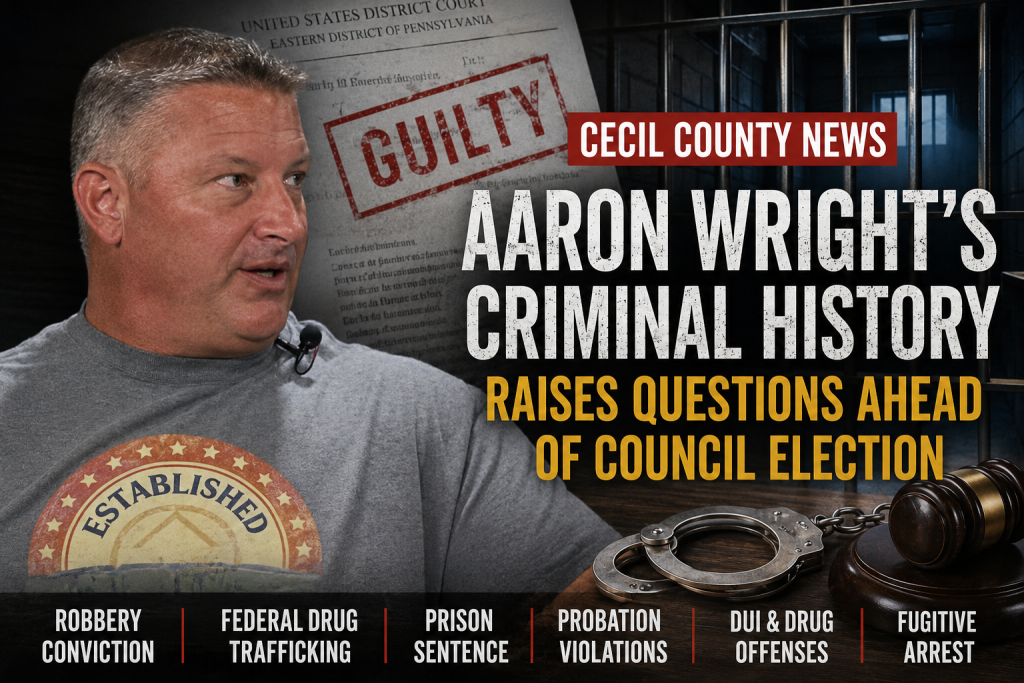
Aaron Wright’s campaign for Cecil County Council District 2 centers on a message of recovery, family values, public safety, and community leadership. On his campaign website, Wright describes himself as a “husband, father, recovery advocate, and community leader,” emphasizing integrity, dedication, and service.
But a review of publicly available court records spanning nearly two decades reveals a far more complicated history—one involving robbery, weapons offenses, drug trafficking, federal prison time, probation violations, substance-related driving offenses, and fugitive proceedings.
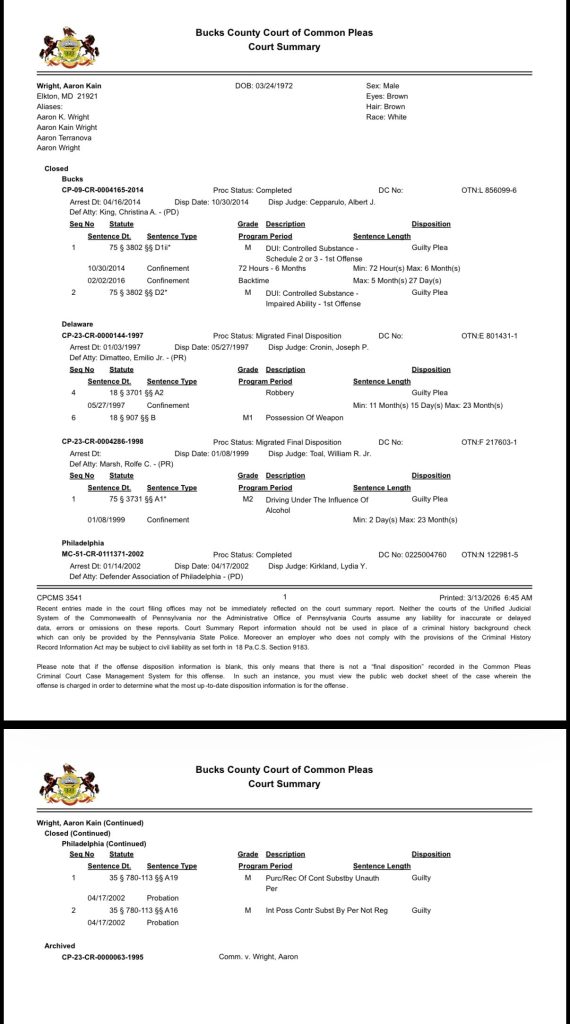
The earliest serious conviction identified in court records dates back to 1997, when Wright pled guilty in Delaware County, Pennsylvania, to robbery and possession of a weapon. Records indicate he received a sentence of approximately 11½ to 23 months incarceration.
In 1999, Pennsylvania records show another DUI conviction.
By 2002, Wright became involved in a major federal narcotics investigation in the Eastern District of Pennsylvania. Federal prosecutors alleged participation in a conspiracy involving MDMA (Ecstasy), ketamine distribution, possession with intent to distribute narcotics, distribution near a school zone, and maintaining a drug stash house.
Wright ultimately pled guilty in February 2003 to federal MDMA distribution charges. In October 2003, he was sentenced to 84 months in federal prison, followed by three years of supervised release, along with financial penalties imposed by the court.
Federal supervision records later documented repeated compliance problems following his release. Court filings referenced missed probation meetings, missed drug testing, failure to attend mental-health treatment, discontinuation of lithium medication, and alcohol-related incidents while under federal supervision.
In 2010, Wright’s supervision conditions were modified to require placement in a residential reentry center for six months. A subsequent 2012 federal filing stated probation officers received notice of a drug-possession arrest and Wright’s admission to renewed heroin use. Rather than fully revoking supervision, the court imposed home confinement and electronic monitoring.
Additional criminal incidents followed even after federal supervision ended.
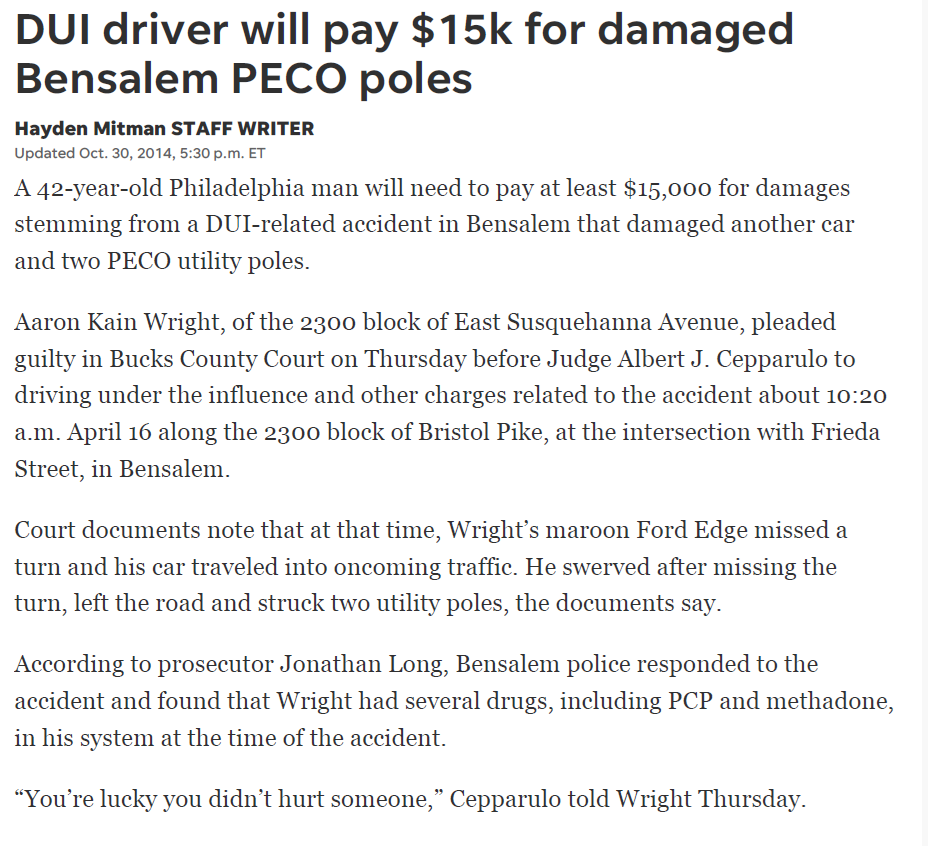
In 2014, Bucks County court records and media reports show Wright crashed his vehicle in Bensalem after crossing into oncoming traffic and striking two PECO utility poles. Prosecutors stated PCP and methadone were found in his system. During sentencing, the judge reportedly warned Wright:
“You’re lucky you didn’t hurt someone.”
Wright later pled guilty and received a sentence ranging from 72 hours to six months incarceration.
Then, in January 2016, Maryland court records show Wright was arrested in Harford County as a “FUGITIVE FROM JUSTICE – PA” and held without bond pending proceedings. Public records do not identify the exact underlying Pennsylvania warrant, though the timing appears connected to a Pennsylvania confinement or backtime entry recorded in early February 2016.
Today, Wright’s public image is heavily centered around addiction recovery advocacy and behavioral-health work. He has publicly promoted his involvement with Voices of Hope Maryland and other recovery initiatives, presenting himself as someone who transformed his life after years of addiction struggles.
Supporters may view Wright’s story as one of redemption and second chances. Advocates for criminal justice reform often argue that individuals who have overcome addiction and incarceration can offer valuable perspective in public office.
However, critics may argue that the totality of Wright’s documented criminal history raises legitimate concerns about judgment, accountability, and fitness for elected leadership.
Those concerns become especially relevant as local governments increasingly oversee behavioral-health funding, opioid settlement money, grant programs, and partnerships with nonprofit recovery organizations. Governance experts frequently note that emotionally sensitive causes—such as addiction recovery and behavioral health—can become vulnerable to weak oversight, political favoritism, or conflicts of interest if transparency and accountability are lacking.
No public evidence reviewed by Cecil County News indicates Wright personally engaged in nonprofit fraud or financial misconduct.
Still, voters may ultimately have to decide whether Wright’s history represents meaningful reform and lived experience—or whether the repeated pattern of criminal conduct, supervision violations, substance abuse issues, and later political ambition warrants heightened scrutiny before entrusting him with influence over county budgeting, public policy, and taxpayer-funded initiatives.
Let talk about the non profit he has helped run for years, voices of hope. They have a 90+% turnover rate with many being able to testify to questionable ethics decisions made by the company. I would love to dive into that part over his criminal background.
That’s similar to basing the prison snitches testimony, their word isn’t credible. You’re going to believe a fresh off the streets addicts testimony lol. Let’s be honest a huge percentage of them aren’t practicing abstinence based principles. If you don’t know, Voices of Hope has made recovery meetings specifically for their type of people, people on maintenance drugs who are still making poor life decisions
i second odin. i worked there and i know personally they have caused 2 people to od and they both died . i would love for someone to truly look into voh. the ground employees are AMAZING.! BUT the top people need to be changed. especially jenn turke and aaron wrights wife erin . i know 100% they try to blacklist anyone they have trained who part with them because they feel they paid for thier training EVEN THOUGH the people who got the training voulenteer for that money and they are on you NONSTOP to log your volunteer hours because they get paid 16$ every hour you voulenteer, cprs cost 2500 you have to atleast volunteer 500 hours so they pay 2500 but make 8000 , thats a 5500 $ profit. but they will call every recovery job around and say dont hire them , luckily my work speaks for myself so i still got a job and my boss told them to kick rocks (they did the same to at least 4 other people) im not saying what they did to me im saying what they did to multiple people, before and after me.