




Why Todd Creek’s Decision to Elevate Larry Waldridge Raises Serious Questions About the Future of the Cecil County Sheriff’s Office
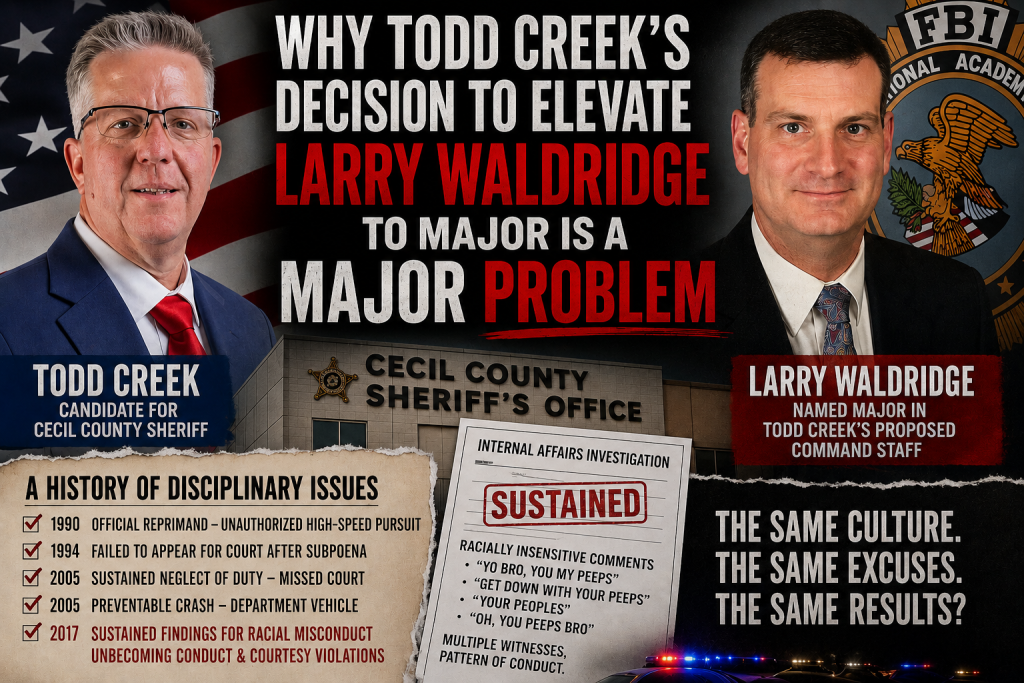
Todd Creek’s campaign for Cecil County Sheriff has centered heavily on professionalism, integrity, leadership, and building a positive culture within the Sheriff’s Office. His campaign platform promises accountability, respect, community trust, and leadership that supports deputies while strengthening public confidence in law enforcement.
But those promises are now colliding headfirst with one of the most controversial personnel decisions of the campaign: the elevation of former Elkton Police Lieutenant Larry Waldridge to the position of Major within Creek’s proposed command staff.
On the surface, Waldridge’s biography on Todd Creek’s campaign website reads like a polished law enforcement résumé. The page highlights his decades of service, FBI National Academy training, management experience, community involvement, and long tenure at the Elkton Police Department.
What the campaign biography does not mention, however, is the existence of multiple internal investigations, sustained disciplinary findings, repeated policy violations, documented racial misconduct allegations, and formal disciplinary actions spanning decades of his career.
That omission matters.
Because the question facing Cecil County voters is no longer simply whether Larry Waldridge has experience. The question is whether elevating a figure with this documented disciplinary history signals a continuation of the very internal culture problems many citizens and former insiders believe have damaged public trust in Cecil County law enforcement for years.
A Pattern Spanning Decades
The internal records reviewed paint a picture not of an isolated lapse in judgment, but of repeated conduct issues extending across Waldridge’s career.
In 1990, Waldridge received an official reprimand after engaging in a prohibited high-speed pursuit involving a non-felony offender. Department policy specifically prohibited such pursuits because of the dangers posed to the public and the department’s exposure to liability.
In 1994, then-Corporal Waldridge failed to appear for a subpoenaed court proceeding despite signing for the subpoena and later being personally contacted and told he was needed in court.
In 2005, another sustained Internal Affairs investigation found Waldridge guilty of Neglect of Duty after again failing to appear in court after being subpoenaed. Investigators documented that the subpoena had been properly logged and delivered. Waldridge later admitted missing court, claiming he had taken leave for a family medical appointment and “inadvertently” failed to notify the court.
That same year, Waldridge became the subject of another internal investigation after crashing a department vehicle in what investigators determined was a preventable collision. Records show he admitted negligence and acknowledged failing to maintain proper attention while driving.
But the most troubling investigation came in 2017.
The 2017 Internal Affairs Investigation
Internal Affairs Case 17-001 involved allegations that Waldridge, while serving as a command-level supervisor, made racially insensitive comments and gestures toward subordinate officers during roll call and on other occasions.
Witnesses described Waldridge:
- pounding his chest,
- using exaggerated hand gestures,
- speaking in what multiple officers described as a mocking tone,
- and saying phrases including:
- “Yo bro, you my peeps”
- “Get down with your peeps”
- “Your peoples”
- “Oh, you peeps bro”
Multiple witnesses independently stated:
- the comments appeared racially motivated,
- the atmosphere became uncomfortable and embarrassing,
- no one else in the room laughed,
- and they believed the remarks were directed at the officer because he was African American.
Investigators concluded the conduct violated departmental policies governing unbecoming conduct and courtesy. The findings were sustained.
The disciplinary outcome included:
- a two-day suspension without pay,
- loss of vacation leave,
- formal counseling,
- mandatory sensitivity training,
- and warnings that future incidents could result in termination.
But the investigative file extended far beyond the March 7 incident.
Witnesses alleged Waldridge:
- referred to a Hispanic officer using the slur “spic,”
- called an officer of Cuban descent “Jihad Joe,”
- made “terrorist” comments toward a Middle Eastern officer,
- yelled “Black Lives Matter” across a parking lot toward an African American officer,
- and repeatedly made racially themed jokes toward minority personnel over a period of years.
Investigators documented that multiple officers expressed concerns not only about the comments themselves, but about the liability exposure they created for the department.
One officer reportedly stated concern that “the department could get sued because one of our command staff is saying these things.”
Questions of Truthfulness and Accountability
Equally concerning were portions of the investigative file suggesting efforts to minimize, rationalize, or deny conduct despite corroborating witness testimony.
Investigators noted:
- Waldridge denied allegations after being confronted with witness statements,
- attempted to characterize the conduct as harmless joking,
- suggested subordinate officers initiated similar banter first,
- and disputed aspects of incidents despite multiple independent witnesses describing similar behavior.
One witness stated Waldridge told her the Chief had not previously spoken to him about concerns surrounding his behavior, despite indications Human Resources personnel believed otherwise.
The investigative summary itself documented concerns regarding a “pattern/history of racial bias” and noted the consistency of witness statements gathered from numerous employees independently.
This was not a complaint generated by a single disgruntled employee.
It was an investigation involving multiple officers, supervisors, corroborating statements, and sustained policy violations against a senior law enforcement commander.
What Message Does This Send?
Todd Creek’s campaign repeatedly emphasizes professionalism, integrity, positive culture, leadership development, and public trust.
Yet placing Larry Waldridge into one of the highest command positions in a future Sheriff’s Office sends an entirely different message to many observers.
It signals that:
- documented misconduct can be overlooked,
- sustained racial misconduct findings are not disqualifying,
- command accountability is secondary to insider loyalty,
- and the same entrenched personalities connected to prior controversies will continue exercising influence over the Sheriff’s Office.
Critics of the current and historical culture inside Cecil County law enforcement have long argued that the problem is not isolated incidents, but rather a systemic pattern where misconduct is tolerated, minimized, politically protected, or quietly rehabilitated rather than meaningfully addressed.
That concern becomes far more difficult to dismiss when an individual with this disciplinary history is publicly elevated as a trusted future Major.
The Broader Concern
No one disputes that Larry Waldridge has decades of experience.
But experience alone cannot be the standard for leadership in modern law enforcement.
The public is increasingly asking harder questions:
- What type of culture is being rewarded?
- What type of leadership is being normalized?
- What message does this send to minority deputies, younger officers, or whistleblowers?
- And how can meaningful reform occur if leadership positions continue to be filled by figures tied to prior internal misconduct investigations?
Those questions are now squarely attached to Todd Creek’s campaign.
And until they are answered directly, many voters will reasonably question whether this represents reform at all — or simply the continuation of a long-standing internal culture that many in Cecil County believe has already done substantial damage to public trust
The complete internal file
When a person in authority can’t even take accountability for his actions with proof from multiple people that is an issue.
Thanks. Very informative.
Where or who were the major donors to Todd Creek? He had more signs up than any of the other candidates combined? His signs were the largest, to the point of being obnoxious. They are everywhere, all l over the county. I didn’t realize being Sherriff is such a big fghing deal! Pardon my ignorance. Something with this election doesn’t feel right to me!