




Segment #1 — The Rise of Cecil Business Leaders (CBL): Origins, Funding, and Access
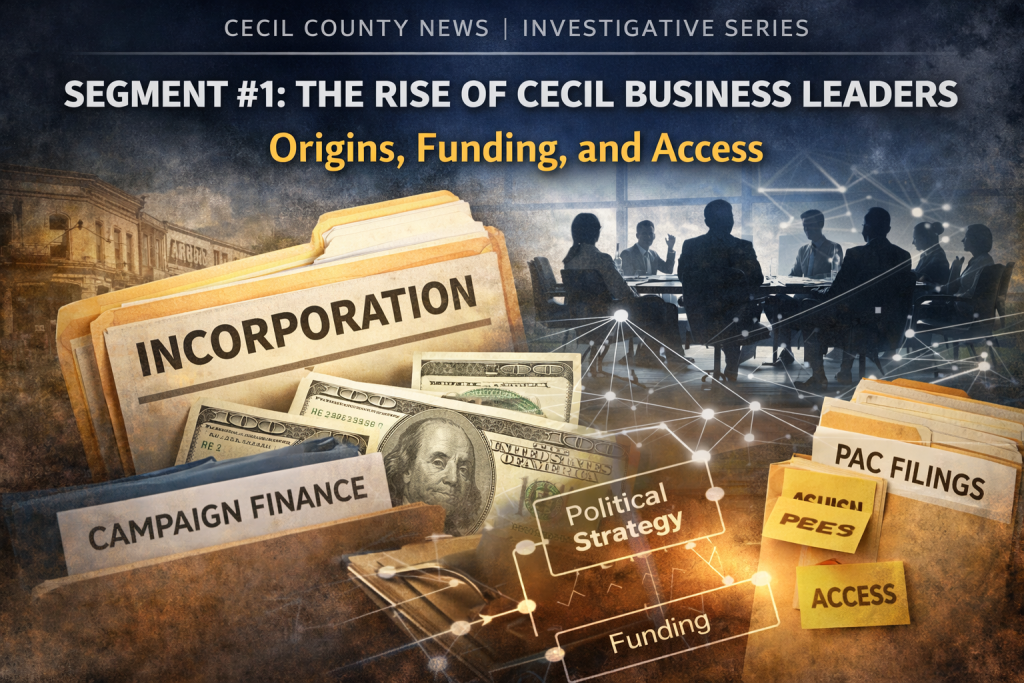
Cecil County News – Investigative Desk
This article is part of the ongoing investigative series, “Cecil County Under the Microscope,” which examines governance, political influence, and institutional accountability in Cecil County.
I. Why Cecil Business Leaders Matters
Before examining allegations of misconduct or ethical failure, it is necessary to understand how political influence was structured in Cecil County.
Cecil Business Leaders (CBL) emerged not merely as a civic association, but as an organized political force whose access, messaging, and resources positioned it to shape outcomes long before controversies arose.
II. Formation and Public Mission
CBL formed during a period of economic transition in Cecil County, publicly presenting itself as a pro-growth, pro-business organization.
Its stated mission emphasized efficiency, competitiveness, and modernization of county governance.
Public records and archived materials show that CBL sought legitimacy by framing its activities as civic engagement rather than partisan coordination.
III. Organizational Structure and Political Reality
While CBL was not itself an elected body, its leadership and supporters frequently overlapped with candidates, donors, and appointed officials.
This overlap created informal but persistent channels of influence that extended beyond traditional advocacy.
Such structures are not inherently unlawful, but they warrant scrutiny when transparency and accountability mechanisms are weak.
IV. Funding Streams and Financial Influence
CBL benefited from concentrated financial support drawn from aligned business interests.
Campaign finance disclosures and public filings indicate that this funding enabled sustained political engagement across multiple election cycles.
The significance of this funding lies not in illegality, but in the scale and consistency of access it facilitated.
IV-B. Charter Government and the Case for Concentrated Power
One of the most consequential structural changes in Cecil County governance was the adoption of charter government.
Charter government was publicly framed as a means of increasing efficiency, professionalism, and accountability by consolidating executive authority.
CBL played a visible role in fostering public support for this transition, advocating for centralized governance as a pro-business reform aligned with economic growth.
This advocacy helped shape the narrative presented to voters, emphasizing modernization while downplaying the risks inherent in concentrated power.
Centralized authority simplifies access for organized interests, reduces the number of decision-makers, and increases the impact of sustained political engagement.
Many residents supported charter government in good faith, believing it would improve governance. However, the long-term effect of such structural concentration is to magnify influence when safeguards fail.
V. Access to Power and Institutional Familiarity
CBL-aligned individuals consistently demonstrated access to county leadership, boards, and commissions.
This access was not limited to election cycles, but persisted through appointments and policy discussions.
The resulting institutional familiarity created an environment where certain voices were repeatedly heard, while others struggled to gain entry.
VI. Early Warning Signs
Even during CBL’s rise, some community members raised concerns about transparency and disproportionate influence.
These warnings did not allege criminal behavior, but questioned whether democratic balance was being eroded.
Such concerns were often dismissed at the time as resistance to change.
VII. Why This Foundation Matters
Understanding CBL’s origins, funding, and access is essential to evaluating later controversies examined in this series.
Power structures precede outcomes. Without examining how influence was built, later events cannot be fairly assessed.
The next segment will examine how this influence translated into coordinated political operations.
Editor’s Note
This reporting relies on public records, archived materials, and documented patterns of conduct.
No finding of criminal wrongdoing is asserted. Individuals and organizations referenced are invited to respond, and clarifications will be published.
This is an excellent article. It expertly explains what the CBL is and how they set themselves up to take control of the county. If you live in Cecil County, this is a must read!
Hidden in plain sight
They shot themselves in the foot by unilateral support for Tari Moore, they did not even interview Pam Howard. It split the Democrat members from the group.